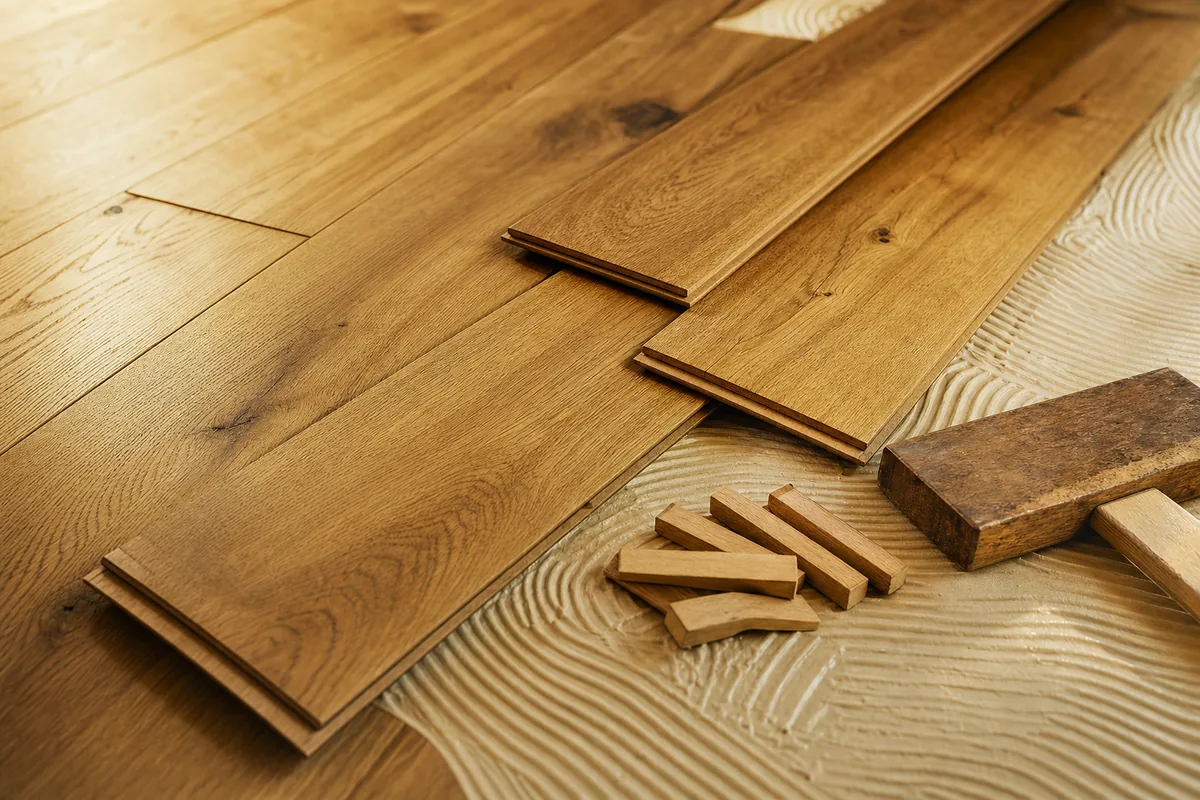
Compare the materials. Then talk about colour.
Durability, water tolerance, cost and honest lifespans in one table — and the subfloor conversation before the sample book comes out, because that is what actually ruins floors.
Six materials, compared honestly.
Filter by the room you are doing and the shortlist gets short fast. Costs are per square metre supplied and fitted, which is the only figure worth comparing.
Engineered wood
$58per m² fitted
Real timber wear layer over a stable core. The wear layer thickness is what you are paying for — 2mm sands once, 6mm sands three times.
- Wear
- Water
- Low
- Life
- 25–40 yrs
- Underfloor heating
- Suitable
Luxury vinyl
$34per m² fitted
The pragmatic answer for anywhere that gets wet or has something with claws living in it. Quieter underfoot than laminate and genuinely waterproof.
- Wear
- Water
- Full
- Life
- 15–25 yrs
- Underfloor heating
- Suitable
Solid hardwood
$76per m² fitted
The longest life of anything here if the subfloor and humidity are right, and a warping problem if they are not. Not suitable over underfloor heating.
- Wear
- Water
- None
- Life
- 50+ yrs
- Underfloor heating
- Not suitable
Laminate
$22per m² fitted
Cheapest per square metre and hardest wearing on the surface, but it cannot be repaired or refinished — damage means replacing a plank or the room.
- Wear
- Water
- Low
- Life
- 10–15 yrs
- Underfloor heating
- Suitable
Carpet
$29per m² fitted
Still the right answer for bedrooms and stairs. The underlay matters more than the carpet and is where most people economise wrongly.
- Wear
- Water
- None
- Life
- 8–12 yrs
- Underfloor heating
- Suitable
Tile
$46per m² fitted
Effectively permanent and the best partner for underfloor heating. Cold and unforgiving underfoot, and cracked grout is the maintenance cost nobody quotes for.
- Wear
- Water
- Full
- Life
- 40+ yrs
- Underfloor heating
- Suitable
It is almost never the material.
Creaking, gapping, cupping and lifting are subfloor problems wearing a flooring costume. A quote that does not mention the subfloor has not looked at it, and the cost of fixing it afterwards is the whole floor.
Every one of these four steps is a line on our quote, priced separately so you can see what you are paying for.
We check level before we quote
A 2m straight edge across the room. More than 3mm of deviation and it needs addressing, whatever goes on top.
Moisture test on anything solid
Concrete slabs hold water for months after pouring. Laying wood onto a damp slab destroys it and voids every warranty.
Levelling compound where needed
Priced separately and shown on the quote as its own line, because it is the thing cheap quotes leave out.
Acclimatisation
Wood and vinyl sit in the room for 48 hours before fitting. Skipping this is why floors gap in winter.
Stock lines
10–14 days
Special order
4–6 weeks
Subfloor work
Adds 2–3 days
Fitting, average room
1 day
Four things that double the life.
Never steam clean wood
Not engineered, not solid, not laminate. Steam drives water into the joints and the damage is permanent.
Felt pads, replaced yearly
They wear flat and start collecting grit, at which point they are sandpaper on legs.
Mats at every external door
Grit is what wears a floor, not feet. A good mat outlasts several refinishes.
Humidity between 40 and 60%
Wood moves with humidity. The gaps that appear in winter usually close again in spring.
Two are about being sold something cheaper.
“They talked me out of solid oak in a kitchen and into vinyl. Two years and a spaniel later, they were right.”
C. Ashworth
Kitchen, LVT
“The levelling compound was on the quote as its own line. Two other firms had not mentioned the subfloor at all.”
N. Petrakis
Whole ground floor
“Told me the 2mm wear layer would never sand and to spend the extra. Glad I did.”
A. Bellweather
Engineered oak
Asked in the showroom, every week.
Which floor is best?+
There is no single answer, which is why this page opens with a comparison rather than a recommendation. It depends on the room, the subfloor, whether it gets wet, and whether anything with claws lives there. Filter by room above and the shortlist gets short quickly.
Do I need to level the subfloor?+
Often, and it is the most common thing missing from a cheap quote. More than 3mm of deviation over 2m makes any floating floor creak and voids most manufacturer warranties. We check before quoting and it appears as its own line.
Can I have wood over underfloor heating?+
Engineered wood yes, solid hardwood no. Solid timber moves too much with the heat cycle and will cup or gap. Tile and vinyl are both excellent over heating.
How long from order to fitted?+
Stock lines are ten to fourteen days. Special order runs four to six weeks, and we will tell you which yours is before you commit rather than after the deposit.
Do you move furniture and take the old floor away?+
Both included on quotes over a certain size, and itemised on smaller ones rather than sprung on you. Old carpet and underlay go for recycling where the facility exists.
Samples first, in your own light.
Free, posted, no obligation. Showroom lighting makes every floor look like a different floor.