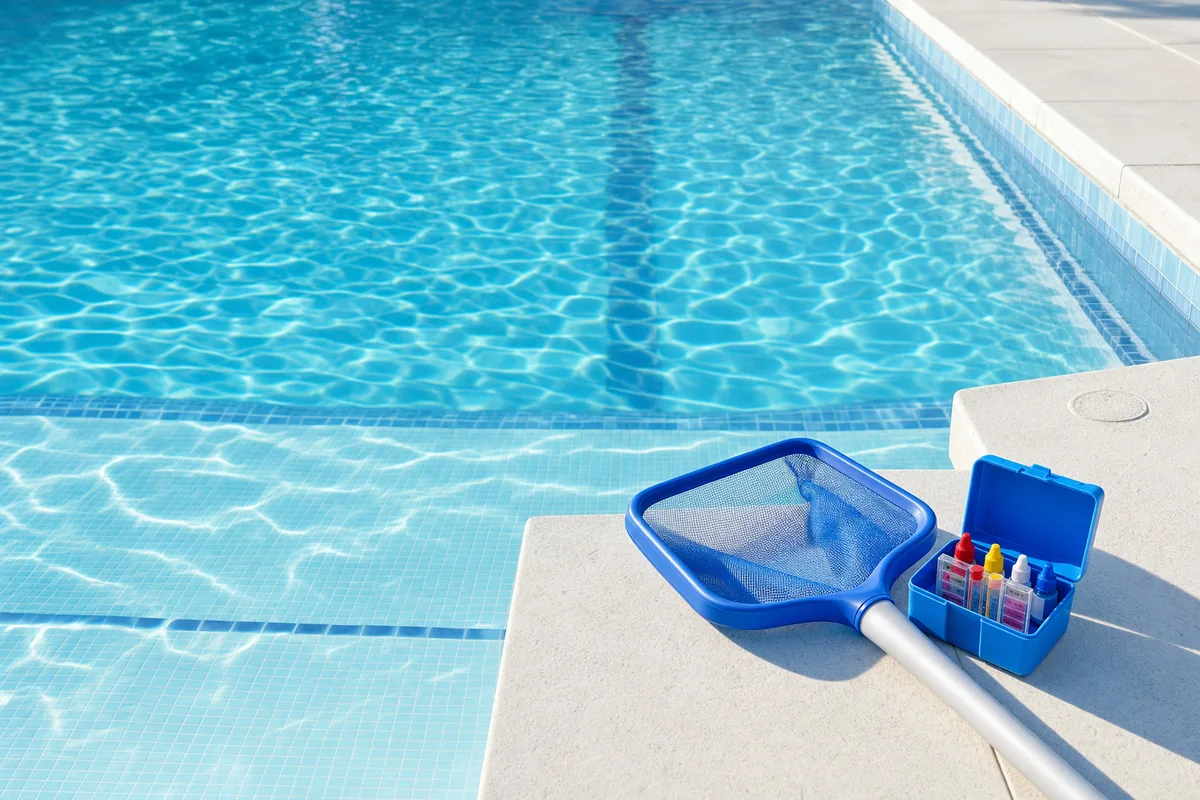
Balanced water. Explained, not mystified.
Every reading emailed after every visit, so you can see what changed and why. This trade profits from customers who feel out of their depth, and it does not have to.
What each number actually does.
Use this on your own test strips. If your service has never mentioned calcium hardness or cyanuric acid, that is worth asking about.
pH
Ideal 7.4–7.6The most important number on the list. Fix this before adding more chlorine.
Too low
Corrodes the heater, etches plaster, and strips the plaster of its finish.
Too high
Chlorine stops working. At pH 8.0 your chlorine is roughly a fifth as effective as at 7.4.
Eight things, in the same order.
Published so you can tell whether it happened. A service that skims the surface and leaves is doing about a fifth of this, and the water will tell you within a month.
The readings arrive by email the same day, whether or not anything needed adjusting.
Full test: chlorine, pH, alkalinity, calcium, cyanuric acid
Chemicals dosed to bring readings into range
Surface skimmed and waterline tile wiped
Walls and steps brushed, floor vacuumed as needed
Skimmer and pump baskets emptied
Filter pressure checked and backwashed on schedule
Equipment visually inspected for leaks and noise
Readings emailed to you the same day
Opening and closing included, not added.
Based on a standard 20,000-gallon pool. Larger or awkward pools are quoted after a first visit rather than guessed at.
Weekly, in season
In season$140per month
April to October. Four visits, everything on the checklist.
Fortnightly, off season
$85per month
November to March. Enough for most covered pools.
Annual
$1,340per year
Weekly in season, fortnightly out, opening and closing included rather than billed as extras.
Green pool recovery, priced before you call.
This is where the trade quotes after hearing how panicked you sound. The bands are published instead, and they depend on volume and severity rather than urgency.
Test and dilute if needed
High cyanuric acid means shock will not work at any dose. Sometimes the first step is draining a third of the pool.
Balance pH first
Shocking at pH 8 wastes most of the chemical. This is why some recoveries take a week and others take three days.
Shock, then hold the level
One dose is not a treatment. Chlorine is held elevated for 48–72 hours with the pump running continuously.
Filter, clean, filter again
Dead algae is what turns the water cloudy grey. This is the stage people mistake for failure.
Repaired before replacement is discussed.
Pumps
Bearing noise and seal leaks repaired. Variable-speed swaps quoted honestly against what you would actually save.
Filters
Cartridge, sand and DE. Media change intervals stated rather than sold annually regardless.
Heaters
Ignition, flow and exchanger faults. Most heater call-outs are flow problems, not heater problems.
Salt cells
Cleaned and output-tested. Cells are consumable and we will tell you where yours is in its life.
One is about being billed less.
“Two years of a cloudy pool and nobody had mentioned calcium hardness. First visit here, they tested it, and it was that.”
G. Mbatha
Weekly
“They moved me to fortnightly for the winter without being asked. Nobody does that.”
R. Feldman
Annual plan
“The green recovery price was on their website. It was exactly what I paid.”
C. Ionescu
Recovery
Two of these have counter-intuitive answers.
Why does my water keep going cloudy?+
Almost always calcium hardness or a filter running too few hours, rather than a chlorine shortage. Chlorine is what people reach for and rarely what is at fault, which is why every reading gets emailed to you after each visit.
Do I need weekly service?+
In season, yes for most pools. Out of season a fortnightly visit is usually enough, and we will move you onto it rather than keep billing weekly for work the pool does not need.
How much does a green pool cost to fix?+
It is published on this page rather than quoted after we hear how worried you are. Most recoveries take three to five days and the price depends on volume and severity, not on urgency.
Why can I smell chlorine so strongly?+
That smell is chloramines — chlorine that has already reacted and is spent. Strong chlorine smell means you need more free chlorine, not less, which is the exact opposite of what most people conclude.
Should I run the pump at night?+
Run it when the pool is being used and for enough total hours to turn the water over. Night running is cheaper on tariffs but does nothing for daytime chlorine loss, so most pools want a split.
Tell us about the pool.
First visit includes a full test and a written assessment, whether or not you take a plan.